The Problem Series

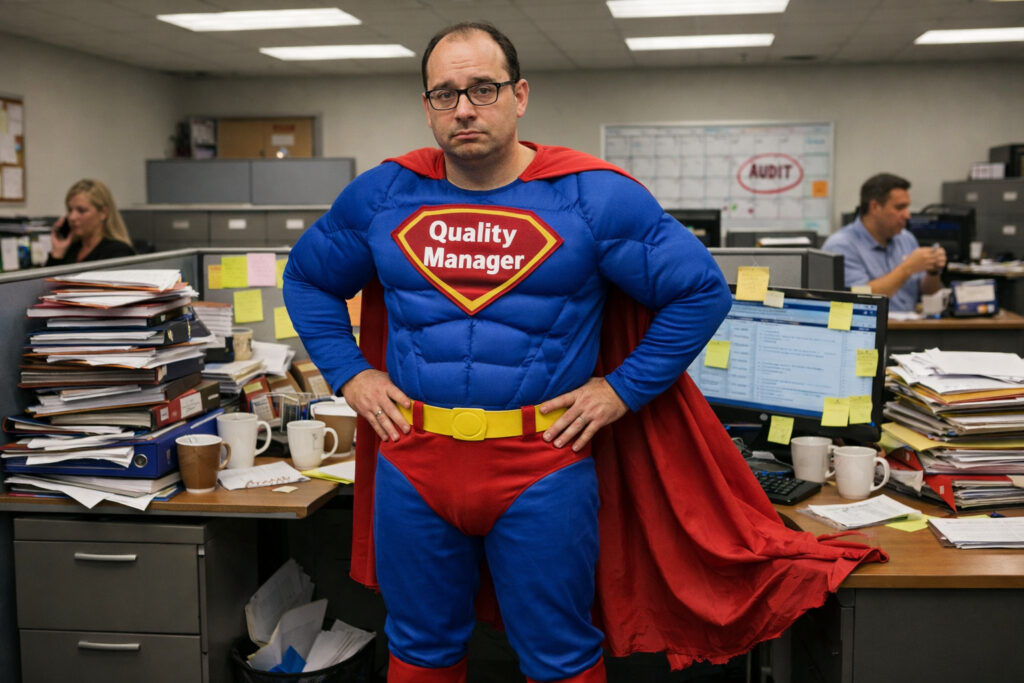
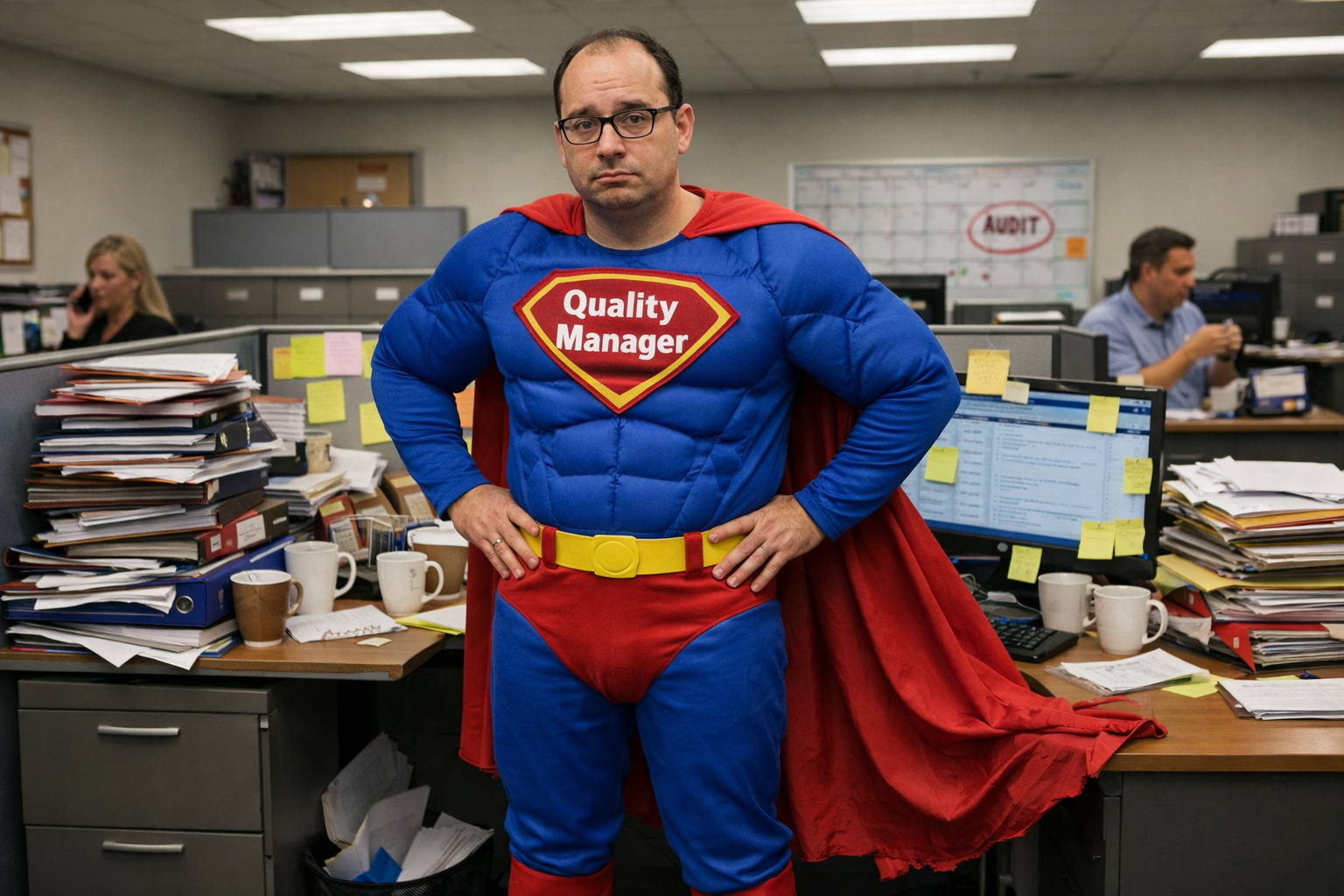
The Quality Manager Myth Most Companies Don't Need This Role. They Need a Better System.

"Most companies do not need a quality manager. They need a management system that puts the expertise they already have in charge of the processes they already run. The role exists where the design failed."
Luis Pertence

9001 Plus Consulting Group Co-Founder & Team Leader

The Diagnosis

Most businesses already have everything they need to run a management system. The expertise lives in their functions. The system just needs to be built around it.

INITIAL SITUATION: A properly designed management system doesn’t need a quality manager to run it. Your business already has the expertise. It is distributed across your functions. The system just needs to be built to use it.
1 1

Ask yourself what your quality manager actually does. Not the job description — the daily reality. Document control. Audit preparation. Chasing corrective actions that process owners should have closed. Writing procedures for processes they don’t run. Sitting in management reviews as the only person who understands the system being reviewed.

None of that work requires a dedicated quality function. It requires ownership — and ownership is already distributed across your business. Your production manager understands production. Your service delivery lead knows how delivery works. Your procurement team lives the supplier relationship every day. The expertise your quality manager is compensating for already exists. It is just not embedded in the system in a way the people who hold it can act on directly.

A management system built around how your business actually operates puts that expertise to work. Process owners define and maintain their own procedures because those procedures describe their own work. Performance measures sit inside the functions that generate them. Problems surface through the people who encounter them first. Management review becomes a leadership conversation about real performance — not a compliance ceremony run by one specialist.

When the system is built that way, the quality manager role largely disappears. Not because someone was made redundant — but because the work it was compensating for no longer exists.

THE MECHANISM: The quality manager role is not a function. It is a symptom of a system that was never embedded in the business that runs it.
2 2

The conventional ISO implementation assigns procedures to functions and then creates one person to keep those procedures alive. That person becomes the system’s immune response — permanently fighting entropy because nothing in the design gives the people inside the business a reason to maintain it themselves.

The dependency compounds quietly. The quality manager accumulates what the system should have encoded: which procedures are current, which records are real, which actions matter, which metrics reflect actual performance. That knowledge doesn’t transfer back to the functions because the system was never structured to hold it there. It accumulates in one role, and the business gradually mistakes that accumulation for necessity.

This is why the role expands instead of shrinking. The longer a poorly designed system runs, the more it needs the custodian. The business starts believing it always needed one — when in reality it built the dependency by outsourcing ownership to a specialist instead of distributing it through the management structure that was already there.

THE CEO CONSEQUENCE: You are paying a salary for a role that a well-designed system makes unnecessary. That is a design verdict, not a staffing decision.
3 3

Most companies do not need a quality manager. They need a management system that is built around their actual operations — one that distributes ownership to the functions that already hold the expertise, rather than concentrating it in a specialist who acts as permanent intermediary between the business and its own system.

The exceptions are real but limited. Highly regulated industries with mandatory quality function requirements. Complex manufacturing environments where product quality risk justifies dedicated oversight. Organisations where the volume of nonconformance genuinely requires a full-time improvement function. For those businesses, a quality role makes sense because the work exists at that scale.

For the majority of mid-market companies pursuing ISO 9001, the role exists for one reason: the system was not designed to run without it. Your production manager knows production. Your service lead knows delivery. Your finance director knows financial controls. A properly designed management system puts those people in charge of their own processes — with the structure to do it — and removes the intermediary entirely.

ISO 9001 does not require a quality manager. It requires a named management representative — a responsibility that takes hours a year, not a full-time headcount. The rest of the role is compensating for a design that should have been done right the first time.

What This Costs You

The Business Consequences

Your business pays for the same ownership twice.

You already employ managers and process owners who should hold the system through their functions. Then you fund a quality role to carry the same accountability centrally — because the system was never built to use the ownership that was already there.

You are paying a professional salary to fill the gap a poorly designed system left open. That budget could fund genuine improvement activity — reducing cost of poor quality, strengthening process performance, building operational discipline. Instead it funds administration that the system’s design created and should have made unnecessary.

When the quality manager maintains procedures for everyone else, line ownership weakens permanently. The people running each function start treating the management system as someone else’s responsibility — because the design tells them it is. Documentation drifts from reality, actions stall, and the system becomes something that happens to the business rather than through it.

When every meaningful answer in an audit comes from one person while every line manager stays silent, the auditor already knows what they need to know. A management system that requires a single interpreter is not embedded in operations. It is parallel to them — and a competent auditor reads that immediately.

A quality function trapped in maintenance has no capacity to improve. Process performance stays flat. Failure costs stay embedded. The business spends its quality budget sustaining what exists instead of building what it needs. Every year the system survives instead of evolves — and the gap between current performance and actual capability gets wider.

The Solution

How We Build a System Your Business Can Run Without a Custodian

We design management systems around the way your business actually operates — not around clause structure or the assumption that one specialist will hold it together. Process ownership sits with the functions that run the processes. Measures live inside the operations that generate them. Management review becomes a leadership tool, not a compliance obligation. For most clients, a dedicated quality function becomes unnecessary.

Others Common ISO Management Systems Problems

Does Your System Run the Business — or Does One Person Run the System?

Take our free self-assessment and find out whether your management system is embedded in your operations — or whether it survives because one person keeps it alive.

Related Case Studies